
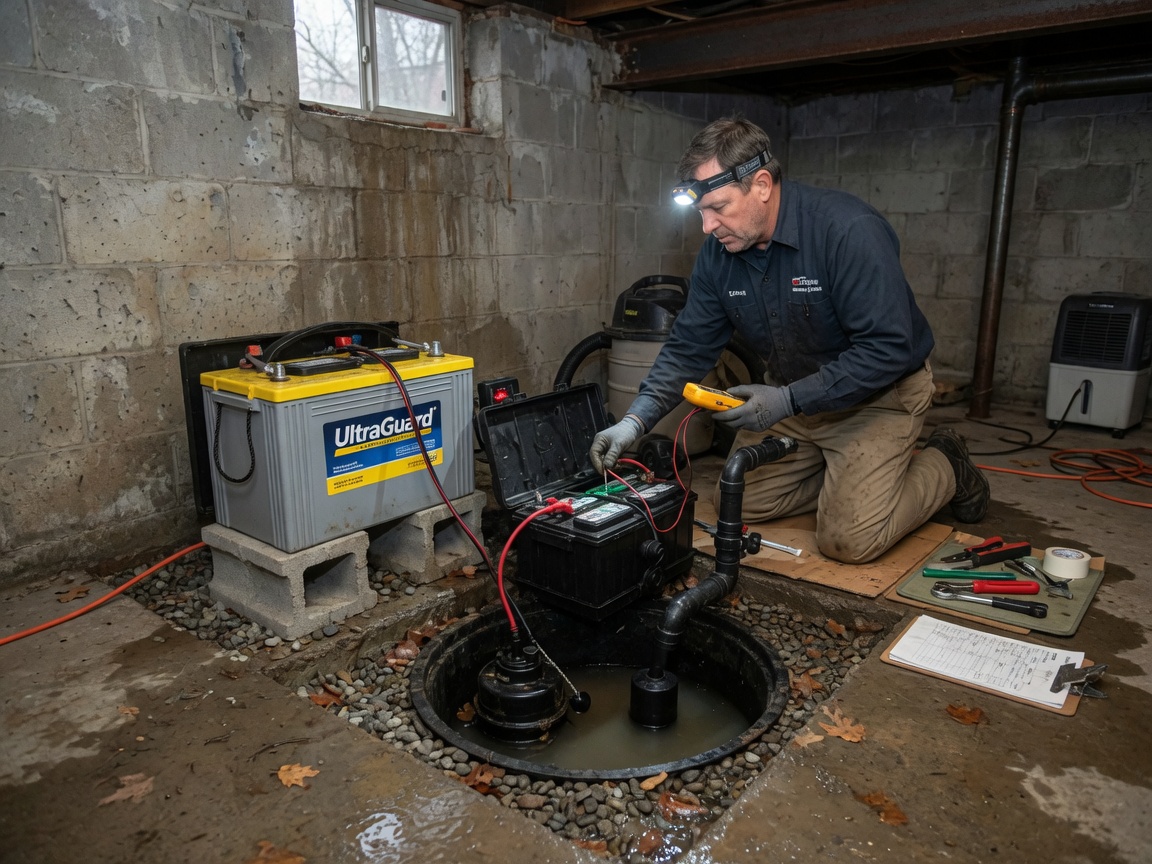
Erie’s humid continental climate brings heavy lake-effect snow that often knocks out power for hours or days, especially in older housing stock found in Downtown Erie, the West Side, and Glenwood. Battery backup sump pump systems use sealed AGM or lithium batteries paired with automatic float switches and trickle chargers to maintain flow when the main pump loses electricity. Homes built before 1970 in these neighborhoods frequently sit on clay-heavy soils with high water tables near the bayfront, so backups must handle continuous 2,000+ gallon-per-hour rates without overheating during extended runs.
Installation requires mounting the battery unit on a dry shelf above the pit, running dedicated 12-volt wiring through conduit, and testing the system under simulated load. Edge cases include partial basement flooding that shorts standard chargers, so we use marine-grade terminals and vented enclosures. Erie County building practices expect GFCI protection on the primary circuit and proper discharge piping to avoid icing on sidewalks during winter thaws, details that matter when a system activates at 3 a.m. during a nor’easter.
Maintenance checks focus on battery voltage, charger output, and alarm function before each winter. In East Erie and near the Erie Zoo, older gravity drains can back up when municipal lines surcharge, making a backup that also powers an alarm critical for homeowners who travel to Meadville or Corry for work. We replace failing batteries every three to five years because cold basement temperatures accelerate capacity loss.
Technician insight
In Erie the thing that catches most people out with Battery Backup Sump Pump System is assuming a standard car battery will last through a multi-day lake-effect outage; the cold, damp basements common in pre-1960 homes on the West Side drain capacity fast and the charger often fails first.
Bayfront Home During January Snow Event
Power failed overnight after heavy snow. The primary pump stopped and water rose toward the finished basement floor. We installed a 100-amp-hour lithium backup with alarm; the system ran the pump for 38 hours until utility crews restored service, keeping the space dry.
Battery Backup Sump Pump System Services We Offer
✓Battery Backup System Installation
Full install of sealed battery unit, charger, and high-water alarm tied to existing sump pump in Erie homes.
✓Sump Pump Battery Replacement
Swap out aged AGM or lithium batteries and test charger output before lake-effect storm season.
✓Dual Pump Backup Integration
Add battery power to both primary and secondary pumps for properties near Presque Isle with high water tables.
✓High-Water Alarm Installation
Wireless or hard-wired alarm tied to the backup system for early warning in Bayfront and Little Italy basements.
✓Backup System Annual Service
Load test, terminal cleaning, and voltage check on existing battery backups serving West Side and Glenwood homes.
Battery Backup Sump Pump System Cost in Erie, PA
| Service | Typical Range | What Affects It |
|---|---|---|
| Basic Battery Backup Install | $900–$1,400 | Single pump, standard AGM battery, West Side or Glenwood homes |
| Premium Backup System | $1,600–$2,200 | Lithium battery, dual-pump integration, Bayfront properties |
| Battery Replacement | $350–$650 | Parts and labor, older systems in East Erie |
| Annual Service Check | $125–$175 | Load test and alarm verification |
Ranges are typical for Erie, PA and confirmed with an exact written quote before any work starts.
How it works
- 1
Site Evaluation
Inspect pit depth, existing pump, power access, and discharge route in the specific Erie neighborhood.
- 2
Battery And Charger Selection
Match amp-hour rating to expected runtime during typical Erie outages and soil conditions.
- 3
Mounting And Wiring
Install vented enclosure, run conduit, and connect float switch and alarm.
- 4
Testing And Handover
Simulate power loss, verify flow rate, and show homeowner alarm reset and maintenance schedule.
Pricing
Most Erie battery backup installs fall between $900 and $2,200 depending on battery size and whether the home needs new discharge piping.